Wednesday, February 28, 2007

The Greatest Albums of 2006


#3 - Thom Yorke's The Eraser

The assumption that Thom Yorke would one day write a solo album had pervaded his career like a mystical gypsy prophecy. Sure, you could predict any of the other talents in Radiohead where just as likely to produce their own material, free from the towering creativity of their band mates (and indeed some have). But Yorke’s was the solo everyone wanted to hear. It was the solo everyone knew they would hear. Amazingly, it was also the solo you could see coming from a mile away, what with Nigel Godrich’s production, Stanley Donwood’s artwork and its downplayed electronic beats (no surprises, please).
And yet, there is a sense of nakedness that helps this album stand above the expected. Whereas Yorke’s work on Radiohead hides behind a shroud of politik, self-speak and indecipherable singing slash wailing, herein he has taken the chance of letting his lyrics be discernible, of telling us about himself and not just the impending doom (although he does touch quite a bit on that). And while some of the album’s lyrics range from poetic to clunky, one element that is never off its game is Yorke’s vocals. With The Eraser he takes chances that he’d never taken before. He stretches his voice out to places it hasn’t been, creating new sounds and new melodies. That, to me, is the main attraction of this album. I am comforted to feel that my personal rock hero still has abilities that he hasn’t yet revealed.
In fact, this should be comforting to the music scene at large. While Radiohead has dispatched massive sea changes in their career, Yorke has remained predictably the same. His paranoia has never died. His disgust remains unshaken. And that’s the thing: can he do anything new?

Yes, and no.

His vocals are awakening places he’s never been, but his lyrics struggle confront something besides the global dilemma (he has to touch upon the me/you dilemma). Songs like Atoms for Peace and Skip Divided try amiably to convey this, but their power pales in comparison to subjects Yorke is truly fascinated by. He reserves his real passion for Harrowdown Hill.
Being an actual place in Oxfordshire, Harrowdown Hill was the site where Dr. David Kelly’s body was found (Kelly, for the uninitiated, called into question the British Government’s participation in the Invasion of Iraq). Culling upon a spooky atmosphere with a throbbing baseline, Yorke trudges up questions and emotions that are both touching and frightening. While the song does criticize the government, it also has Yorke attempting to empathize with the dead party.

Clearly, this is where his mind rests for most of the album.

Godrich and Donwood follow his lead, with Godrich creating a sparse, yet poppy landscape for Yorke’s voice to play in. Meanwhile, Donwood lays out some of his finest art yet…an encompassing woodcarving of a man trying to hold back the sea and every last drop of hell ready to be unleashed on mankind. One is liable to think that inconsequential figure to be Yorke.

Listen to modern radio after this superlative and you’ll come to the conclusion that it might as well be.

That little spastic man with the crazy eye. Does he hunch into the corner of a dark room, banging his head against the wall, scribbling lyrics while listening to the sound of rain pattering against the window layering over the scratching of rats' claws against the walls? I'm sure myriads of fans have such dark, romantic visions of Yorke's writing process. Perhaps they're accurate. He just may be the Edgar Allan Poe of music.

Upon first listenings I couldn't think of The Eraser as much more than Kid A, minus the rest of the band. The rest of the band's creative input "erased" out. But it's not. Where Radiohead output the equivalent of a novel, Yorke writes the brilliant short story on the side. Is the novel greater than the short story by its size, or weight? Surely not, as a novel can be bloated, belching out the excesses of broken-down waste (not saying that is what Radiohead is).

Sure, The Eraser cannot escape familiarities with Radiohead. After all, Yorke is "the voice" of the band. But this album does not stand below the work of Radiohead, but next to it, at someplace on its own. Boom-clack-booms, electro-sounds and keys flow through the aorta of the album, with sparse, but fitting guitar. There's also some very interesting bass work on some songs by Nigel himself, especially Black Swan and Harrowdown Hill. The latter featuring dark and brooding slap.

Along with Brock, I too noticed Yorke stretching the vocals, most notably on tracks six through eight. In fact they are my favorite tracks to listen to, and I love that they are all in a row. I'm taken aback by Yorke's tortured croon of "I...I can never reach you" on And It Rained All Night. Perhaps he's referring to those who "don't understand Radiohead," which, inevitably means...Yorke.

Tuesday, February 06, 2007

The Greatest Albums of 2006


#4 - Beck's The Information

The thing about Beck is that he’s innovated so much, its now hard to think of new genres of music for him to mix. Think about it: he’s touched rock, hip-hop, disco, techno, folk, pop, jazz, art-rock and even had a few moments of soul. That being said, he claims his latest album The Information is his take on the hip-hop scene. Yes friends, we’ve finally reached the day where Beck has run out of things to innovate. He’s now pretending to have “discovered” hip-hop.
Career commentaries aside The Information is a great album. But his “newfound” fusion of hip-hop and 60’s/70’s rock isn’t the reason why it’s great. Rather, The Information stands high on this list because of one thing and one thing only.

It’s simply a well-thought out album.

I dare you to listen to The Information, an album Beck has been struggling with since 2003, and not hate his last work Guero. I dare you. For me, it’s suddenly easy to see Guero as filler meant to tide us over until he could work out this hard-edged masterwork. Guero seems like a scattershot, and Guero a death-blow.
According to several accounts, The Information was the first thing Beck and Godrich began working on following the darkly introspective Sea Change. But somewhere down the line, The Information became too painful an album for Beck. It was too daunting. And so, he shelved it in favor of Guero.

A mistake.

Listening to The Information is a revelation in the sense that it is an immediate progression from Sea Change. Whereas Guero felt like a reversion to Beck’s daytime TV, The Information picks up right where Sea Change left off. It is brooding, contemplative, bitter, and oddly enough, hilarious. One masterful development in Beck’s recent work is the darkening of his playful, junk-culture persona. Once cute and nostalgic, Beck’s interest in the realm of all things sub-culture now seems snide and edgy. Each game boy bleep in place of drums is infused with a tone of mockery. Face it, Beck hates you, and he’s using Tetris to explain why. It’s marvelous.
Equally impressive is Godrich’s masterful production. Take note of the title track, The Information, in particular. So many layers of sound hum in and out of dangerous proximity, so much sounds so cold and seems so warm. Clearly, this is the album Godrich wanted to make. An album where Beck is the bad guy, where the production can be ramped up as much as possible and Beck’s tar-pit discontent still sneers right through. It’s the album Beck never wanted to make, but that we all wanted to hear.

In order to get this list out before 2007 is over, I have to write up limited commentary on this album. I couldn't conjure up much to say on this one. That's mostly because I didn't get to listen to it enough. But it was enough to know I liked it. I was a fan of his early work, and my interest tapered off after "Mutations." Interestingly enough, "The Information" feels like a dark blend of "Mutations," or "Sea Change," with "Odelay." And that makes for a tasty blend indeed.

Godrich's presence is apparent on this album. It has wonderful bippity-boom beats, spacey sounds, and dark, brooding guitar work. This album just may have gotten me back into Beck.

Tuesday, January 30, 2007

The Greatest Albums of 2006


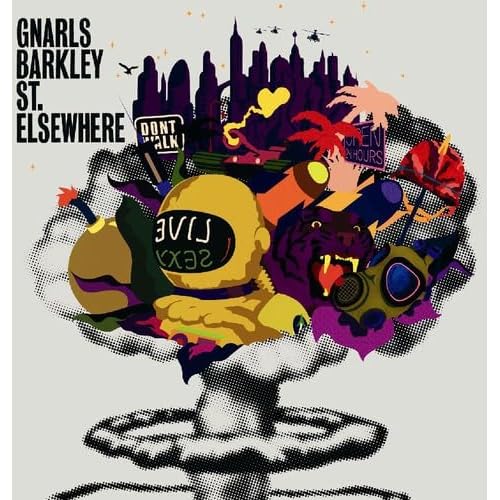
#5 - Gnarls Barkley's St. Elsewhere

Oh dear readers, it is but by the grace of Gabe that this album is listed at number 5.

A short while back, when we were discussing placement for our albums of the year, I hastily put St. Elsewhere at the very bottom of the list, on the merits that it just wasn’t as artistically inclined as the other works. Gabe argued the album’s case however and managed to convince me that it should be higher on the list. I was still a bit hesitant over this decision. And then, in my effort to reconnect with the album before writing this list, I began to see why he fought to have it placed so high.
St. Elsewhere isn’t brimming with artistic merit or credibility, but it is perhaps the one album we’re talking about that actually made cultural waves in 2006.
Created by DJ Danger Mouse and Cee-Lo Green (the duo behind Gnarls Barkley), St. Elsewhere is a hip hop revelation in a year where faces like Kanye West and Common are absent. Driven by the eclectic sound of throbbing baseline and car-crash drums, St. Elsewhere is the closest thing 2006’s music got to fun for me.
Part of this can be attributed to the album’s hip hop revisionist sound, (present in smart tracks like “Crazy” and “Just a Thought”). These songs, which ruled the airwaves this year, seem fueled by true honesty, emotion and a unique perspective on the musical and cultural landscape (despite confusing, pointless lyrics that suggest otherwise). And in the album’s finer moments, St. Elsewhere ceased to feel like DJ Danger Mouse’s latest grab for a scene and more like an honest musical statement.
While this may be the result of Cee-Lo’s tremendous presence, the honest effort on the part of both musicians to create a work that elevates itself above a joke is intelligent.
I might also add in a quick aside that Cee-Lo establishes himself as front man of the year with this work. His buoyant charisma gave resonance to St. Elsewhere and made this album relevant. Danger Mouse’s production will always be praised in reference to this album, but the voice of Cee-Lo is what made such high-production human.

That being said, it is but by the grace of Gabe…and the accomplishment of Gnarls Barkley that you get number 5.

"By the grace of Gabe!" Oh man, that is hilarious.
The end result of teaming Cee-Lo Green and DJ Danger Mouse is reason alone to rank this album high. Not many people knew of Cee-Lo and Mouse in 2005. More Mouse than Cee-Lo, as the DJ had quite a bit of notoriety mixing Jay-Z's "Black Album" with the Beatle's "White Album," resulting in, of course, the "Grey Album." But put them together as Gnarls Barkley in 2006, and Bam! They're hitting the airwaves, bringing hip-hop/r&b delight to the homes of the radio/MTV-limited, young generation. And with that, hopefully it sparked a dead synapse or two, that will motivate them to expand their field of music.
I agree with Brock, in that Cee-Lo is the highlight of the duo on St. Elsewhere. He's unique for an R&B singer, in voice and personality. He has the charisma of James Brown and a great vocal range.
Songs on the album delve back-and-forth, and mix together hip-hop, R&B, and dance. It's a lively album that, although didn't make any major breakthroughs, was a breath of fresh air on the radio.

Friday, January 26, 2007

The Greatest Albums of 2006


#6 - Asobi Seksu's Citrus

Occasionally, I wonder how someone would overcome suffocation in a looming megalopolis like New York City or Shanghai. Millions of people teem everywhere, like bugs in a bathroom. What’s more, with the metallic surfaces and grimy cold pavement around you, I would think city dwellers get the overwhelming sense that they just don’t matter. How else can you define self-importance in such a daunting atmosphere?
I found my answer amid the crushing, crunching guitars of Asobi Seksu’s oddly feather-light “Citrus”, the 6th record on our Best of 2006 list.
Headed by Yuki Chikudate, Asobi Seksu manages to deliver the first real album on our list. While both Owen and Dylan are notable entries in this year’s music scene, Citrus is the first album that leaves the listener with a distinct “residue”. A literal wave of sound, Citrus pulses underneath with a sense of rhythm. It has a heart.
Upon listening to and discovering that heart, our heartless world seems endowed with an ethereal quality. Yes, one’s day-to-day routine, so insignificant before, takes on a sense of epic import. It is this empowering, feel-good nature that elevates Citrus beyond a typical Shoegazer enterprise.
Tautly structured around a number of pop-songs and a pair of 5 and 7 minute epics, Citrus seems driven forward with a purpose. That purpose is anyone’s guess. This in itself might initially be seen as the one true fault of this album: a sense of motion without motivation.
Indeed, Chikudate’s vocals (buried, distorted and occasionally in Japanese) seem to be telling of a man trapped in a car beneath the sea, with only the lighting above to illuminate the murk. The same lyrics could also be about a boy and a girl.
Ultimately, Citrus isn’t about the motive or the purpose that defines the feeling, but rather the feeling itself. It is that sense of immensity that helps Citrus to transcends events. The music instead chooses to speak to the intuitive heart.
Tracks instrumental in this impression include “Thursday”, which beautifully echoes and sparkles across the progressive throbbing of Mitch Spivak’s drums. Elsewhere, “Goodbye” serves as a twangy gasp for air following the crushing might of “Red Sea”. Quite possibly the most singsong of the collection, Goodbye is also the only real distinctive love song. “New Years” is an unleashing of the band’s guitars, full blast…and it hits like a hailstorm of cheetoes.
As a result of these songs and others, the record leaves us with that distinctive residue that is often lost amidst other albums waxing on lost love, found love and everything in between. It is this residue of importance that seems to infuse even a drive across the freeway with some significance.

In an unimpressive life, that is impressive. -Brock

Brock, I meant to make a copy of this CD before I gave it up to you. I may not have liked it enough to keep it, but it was worth a copy for listening. Plus, it only leaves me with my faint memory as reference for review.

I was immediately taken aback when I first listened to Thursday, which I had downloaded. Often labeled "dream pop," it is clear to hear why. Guitars glimmer and grind with reverb, back and forth, over pop-coated rhythms and "new wave" bass. Top that off with Yuki's dreamy, high-pitched vocals.
From the song "Thursday" alone, I was eager to see them live, when I learned they would be playing in town. They did not disappoint. Many songs had crunching guitars and powerful drumming, tapered off with Yuki's keyboards and vocals. The only drawback I experienced, was that Yuki's vocals were sometimes a distraction, reaching high-pitch levels that seriously gave me imagery of a female chipmunk. However, their live performance was so impressive, I was drawn to purchase their album after the show. I discovered Yuki's vocals weren't so grating on record.
Though I appreciated the album overall, I couldn't really get it to envelop me. I had purchased a couple other albums at the time, and couldn't take myself away much from one of them. That may have pulled my needed attention away.
Brock, I'll need to get a copy. -Gabe

MP3: Asobi Seksu - Thursday

Thursday, January 18, 2007

The Greatest Albums of 2006


#7 - Owen's At Home With Owen

Delicate finger-picking, soft strums, and wispy vocals that can crescendo into off-key crooning. His soft, low-key music will throw the listener off-guard when noting the sometimes brash lyrics. The first track, Bad News, starts the album off:
you're a has-been
that never was
I know it's mean to say
but it's something I've been meaning to say to you
for a while

So is the style of Mike Kinsella, formerly of emo-punk darlings Cap'n Jazz, and sorely missed American Football.
His previous albums differ only slightly in musicality from each other. On his fourth album, however, he adds a splash of strings and piano. It's a nice touch, but he ultimately sticks to his original formula. That's a plus for me. There's no sense in changing a good thing.
A standout on the album is his cover of Lou Reed's "Femme Fatale." For one, I believe it's his first cover. Secondly, he makes this rendetion all his own. Overall, another good effort from Owen. -Gabe

The more I listen to this album, the less it feels like an album. Instead, Owen’s “At Home” comes across as a subtle afterthought. That may sound like the king of all backhanded complements, but in not grandstanding, not making tremendous footprints in the musical landscape, Mike Kinsella has found his primary virtue: remaining a source of musical beauty.
This album is beautiful.
Each and every track is utterly mesmerizing, a work better devoted to long afternoons spent above a snowy landscape with the one you love. Or, conversely, it will be used as the bitter cry of one who has nothing to love, save for the melodies being picked at herein. Whatever the case, Owen has unleashed the perfect album for an overcast day. Some albums are good enough that they can transcend season, time and remain relevant for whatever period one’s life is in. That is not the case with this album. “At Home” feels as if its power will fade the moment winter passes away. Maybe that’s not the case; maybe it is in fact exactly what the alone need, from hot summer days in empty corridors, to cold winter days at a bus stop. And it just may be short enough to keep such ones from slipping into self-parody.
Sure, you could ask yourself “do we really need another one of ‘those’ albums”? And the answer is probably, “no”. But this album gains some notoriety through the fact that it exists in such short breath. In the blink of an eye, it comes and it goes. It is simple enough and strong enough to stand on its own, and yet it leaves so much unsaid, unexplored. And I’d like to think for good reason: it isn’t about what you show, about what you sing, but rather about what you don’t. At Home With Owen is about 8 tracks of remorse, regret, longing and hope. These days, such a record ought to be banished for speaking about such things in the same breath as the plucking of an acoustic guitar. As it is, the album seems short, sweet, and right at home. -Brock

MP3: Owen - Bad News

Tuesday, January 09, 2007


The Greatest Albums of 2006


#8 - Bob Dylan's Modern Times


The reason why I’ve got Bob Dylan’s Modern Times on the Greatest Albums of 2006 is quite simple: Taut control. Never is this quality more clear than in the opening track, Thunder on the Mountain, which begins in a state of absolute confusion; instruments swell and clatter over one another, strings seem to breathe in and out, the song is simply existing. And then, Dylan’s mastery kicks in and suddenly a rhythm is found. The song begins to move forward. He explodes with energy. In those first few notes, the virtue of Modern Times becomes abundantly clear.
Modern Times never struck me as an effort to forward the craft of songwriting, nor did it strike me as an effort on Dylan’s part to live up to the unimaginable legend he has become. Rather, the album seems to exist solely as an exercise in sheer songwriting capability. A presentation of what has already been developed, it is a nicely written letter to us, his listeners, in which Dylan muses somewhat conflictingly on the value of legend. That is what resonated with me so deeply on this album: his outright contempt at the idea of proving himself all over again. And yet, he also seems brimming with the energy to do so.
Just reason on the lead track, in which he jeers at us, “I’ll say this, I don’t give a damn about your dreams”. He continues later with, “I’ve already confessed, no need to confess again”. He might as well be telling us to get lost. But the counter-balance to this venomous lyricism of course comes in the form of the melody itself, seemingly a straight rip off of “Johnny B Goode”.
Yes, to me Dylan is praising and cursing the past all in the same breath. He’s borrowing it, reinventing it for the standards of today. Maybe Modern Times exists as a continuation of great songwriting long past, and maybe it simply exists as a way for him to tell us to forget what’s come before. Maybe neither.
Modern Times gets it right because it’s deliciously crafted. It isn’t edgy, and it certainly isn’t unexpected. You can see each track coming from a mile away. Spirit on the Water utterly echoes long before Thunder on the Mountain is over. And by the time he gets to Nettie Moore (a fantastic track I must say), Dylan’s ode to the old masters, using the very songs they created, is clear. But it’s all in good form. It’s circular. It’s comforting. It is a collection of well-written songs that you could almost swear you’ve heard in one form or another. But, no matter. You could look for themes in Modern Times until the end of time. But the subtle power and grace of its songs is all that makes this album a worthy contender. This is sinewy songwriting at its finest. And it damn well knows it. -Brock

Brock and I didn't have the luxury of owning every decent album that came out in 2006 to review. And good thing! Who has that kind of time, but a well-staffed zine, be it in glossy paper, or a website? In fact, the eight albums reviewed, are a combination of both our 2006 catalogs. Pitiful, but it's what we have, and it's what you get.
Brock gave me a CD-R that was supposed to have Dylan's Modern Times burned on it. However, it did not. I forgive you Brock. It may have cost Dylan some spots on the list, not sure. -Gabe

Tuesday, December 19, 2006

Albums of 06

Gabe and I are definately going to post our favorite album of 2006. He's "lending" me the records I don't have for this year and vice versa. We'll both narrow down the selection from about 12 albums or so to one single great album. Should be fun!

Friday, December 15, 2006

Bond...James Bond...

Review: Casino Royale

Since the moment he wryly asked for a martini, shaken and not stirred, James Bond cemented himself as an icon of filmic history. True, he hasn’t exactly been the cinema’s most original icon, but he has remained an icon. Once Bond’s torch moved beyond Connery however, his repetitious nature and slant towards action fare dissolved from charming into pointless. By the time Bronson picked up the character he was nothing more then a bag of clichés that had long since lost their spike.
With Casino Royale, the 21st installment in the Bond franchise, director Martin Campbell and his writing team of Neal Purvis, Paul Haggis and Robert Wade attempt, not to reinvent the legendary secret agent, but rather to return meaning to this legend. Having long been outpaced by other film heroes, Bond is given a chance to reclaim his throne. And with a new face behind the character (Daniel Craig) one asks, “Is the attempt at rejuvenation successful?”

What one should be asking is: Why does Casino Royale work when so many Bond films don’t? Simple; the filmmakers stopped treating the source material as one more unit in a long line of units and started treating the characters, the story and the settings as individual ingredients in a legitimate film. To my enjoyment, this movie doesn’t feel like a faceless Bond film, it feels like a film. It has its own nooks and crannies, its own voice. And the filmmakers all have so many ideas invested in it. The screenwriters have genuinely poured their hearts into each act of the story. The actors have created tremendously huge characters without the aide of what’s already been established. The cinematography is beautiful. By my count, it’s the first Bond film where the filmmakers sat down and thought the damned movie out. Beat for beat.
The result? Casino Royale is genuinely entertaining and enthralling. For that matter, Daniel Craig has created a Bond that isn’t just a quagmire of innuendo and gadgetry; he has created a Bond that is oafish and cast asunder by his own hubris, yet also blessed by his own cockiness. He created a thug. And more exciting then that, this is the first Bond film where its namesake truly gets beaten up. Not just by the villains, but by his superiors. He’s good, but not great. He’s witty, but not outright irresistible. He’s inadequate.
And his foes? They are good…damned good. They’re not just a group of pointless masterminds bent on ruling the world; they’re individuals dealing with their own set of pressures just as Bond is, and they possess skills that equal or surpass Bond’s own. Take Mads Mikkelson as Le Chiffre; he bleeds out his eyes when he’s stressed, looks like a throw-back to Connery-era villainy, and periodically sucks on an asthma inhaler. But at the card table, he schools Bond. Le Chiffre is a unique character and thankfully not just some guy pieced together because (doh) the film needed an antagonist. In summation, his poker-skills and overall influence upon the dramatic premise of the film aptly illustrates why this film works so well: everything is connected. Very little in this film is random or tossed into the mix just for extra bang. To quote Sunny Day Real Estate, “everything and everyone, and in the end we all are one”. This completeness, this sense of a unified whole helps advance Casino Royale into a realm of entertainment that even puts J. J. Abrams’ own Mission Impossible III on shaky ground.
Of course, the film does have its faults. Namely, it is extraordinarily long. But, its so thoroughly enthralling, so welcomed that such faults are easily overlooked.

The downside to this new approach to the Bond franchise is apparent however. Never again can they rightfully go back to the humdrum they poured out before. Having watched this Bond film, it will never be acceptable for the film’s producers and star to churn out mediocre and claim “sorry, we did our best”.

So many will respond, “oh, that’s not true”.

Coming Out of Lurkness


By now you've come to expect major droughts between my posts. So, what's noteworthy as of late? Not much in the way of movies. Not that there hasn't been any good ones (that may be the case), but I haven't had the opportunities to see much. However, I have come across some really good music.


Mew. Although deservingly making Pitchfork's Top 25 Worst Album Covers of 2006, I was immediately blown away by their song, The Zookeeper's Boy, upon first listen. It's so "over-the-top" prog rock, that it's cool. Brock will have to tell us more about them, as he's purchased the album. I need to get my hands on that!


Owen. New album. Good Stuff.


My Brightest Diamond. Opera trained voice, rockin', cute. What more do you want!? A song? Fine.

Thursday, December 14, 2006

Farewell Scottsdale Community College

A new unspoken high school ritual is for some jock to play the Green Day song Good Riddance (Time of Your Life) on a warm acoustic at graduation. It’s cute. Preppy girls cry. In fact, nearly every student who valued those pointless four years cried. Part of me wonders if I’m disconnected from human experience on the whole, because at my graduation ceremony I did not cry. I guess I couldn’t feel what they felt.

But I swear to you, had some jock jumped in front of that dinky little TCM 245 classroom tonight (the very same classroom where I had my first production class at SCC), I would have gotten teary.

Yes, this evening, the venture known in my life as Scottsdale Community College came to an end.

Why would I have never even cried at High School, but considered it at SCC? Simply put, I had a role in what happened at this film school on the fringe of an Indian Reservation. I wasn’t a legend (far from it) but I was a character in the drama that unfolded around this hidden nook of campus. That in itself is of incalculable value.

Some consider my occupation at this school to be for the worse. I’ve been told that I’ve wasted my time. Do I consider my tenure at SCC to be of a negative impact? Not in the slightest; one thing I’ve learned this semester is that the finest individuals in the business are shaped by the experiences they’ve had in life. And yes, bad experiences are included in that. The worst filmmakers? They are the ones who instead create their own silent, white void. They mute.
With that in mind, being at SCC hasn’t strictly been a series of bad experiences, and it hasn’t strictly been a series of good experiences (lord no). It’s been both. But the most empowering experiences for the creative mind are those which reek of both the disquieting and the rosy. Both are illumination, but of a different breed. When I walked out of SCC tonight, I wasn’t just some kid who had participated in that community for the past two years. I shaped it. We built a tent in the school’s studios, loaded film in those studios. I bled in those studios! I saw a plethora of boys and girls peak and recede through my tenure…co-conspirators like Chad Einwalter who gave way to confidents like Drew Hoffman. I started school in the same classroom and ended it in the same classroom, but watched those sitting around me change in between. These people, these experiences shaped me into the person I am tonight…and from here on out. I learned that I am the main character in a film that only I can watch.

That being said, Green Day’s pop angst wasn’t appropriate for what I felt tonight, for the grand summation of my pain-riddled, harrowing adventure. As I strode out of that school, past the studios, past the dinky classroom, I played Psychocandy’s “Just Like Honey”.

Next time you’re wandering around SCC at night, dear reader, play that song and take a stroll down the walkway wedged between the LC and AP buildings. You won’t feel good. You won’t feel bad. You’ll feel what Brock H. Brown felt.

Wednesday, December 06, 2006

What's next???

So, what’s the next screenplay going to be about?

Lord, I honestly don’t know. I have two ideas that I’m teetering between. Now that Documenting Ambler is done, I’m trying my best to determine what I want to write. Where will my mood shift? In all honesty, I have yet to finish Sin of the Opiate. But, I will do that over the Christmas/New Year period, hopefully. That screenplay writes itself (sort of)…it was always just a matter of finding time to write it.

Time, I now have in spades (or will soon have in spades).

Sin of the Opiate, I am sure, will dramatically change my mood and set me up for whatever it is I want to write next. Will I want to write a happy screenplay, complete with Hollywood stylization, or something a bit more serious? Perhaps I’ll even step towards something a tad edgier, less commercial? Whatever it is, I have to get something ready to write by the beginning of the year, because I have to keep going. This is it. This is the testing period. School will be out. If I can’t sustain myself through a steady output of writing, I’ll never have enough ammunition once I get myself past the door. That is, IF I get myself past the door. One obstacle at a time…at a time…

Two ideas – YES! I have two ideas that I am playing around with. One idea is ludicrously grand, could only be filmed by a name director, would be highly commercial, and would require a massive budget. I am of course talking about my Napoleon screenplay. Beyond the grandiosity of the idea, I ask myself – “do I really want to write this again?” Haven’t people come to expect this sort of thing from myself? Doesn’t Sin of the Opiate accomplish what this movie accomplishes, and in much more original terms?

Sure, sure – the central characters and conflicts in both movies are deeply unique. In Opiate, we have a Limehouse clinger-on who has to battle his addiction amidst the backdrop of a larger conflict. In Napoleon…well there’s only one-way you can take it, and that’s ego.

You don’t start at the beginning; you start at the beginning of the end: The Hundred Days. You base the movie around Napoleon’s return to power, when he’s ludicrously mythical to the European populace. The story begins after his exile. England and several other countries are gathered together to discuss just what to do with their corner of the world, now that old Napoleon is gone. Aristocrats plan marriages to unify bonds and bring together countries. And at the head of this return to Royalty is our villain in the story, the Iron Duke himself. Things are going splendidly. The Aristocrats will be in power again. England shall expand her power. Everyone’s pleased.

And then word breaks. Napoleon has returned.

What’s so amazing about this story is that, as Napoleon marched on the capital, tearing down the ambitions of these Aristocrats along the way, the media’s opinion of him shifted. First governed by Royalty, the press sniffed at his return, calling him a traitor and a criminal. By the time he entered the capital to take back his empire, those very same papers were hailing him as their lord and emperor.

The thing that’s also so cool about this story is that Napoleon built an army and took back Europe, NOT through specific actions…


…But through fear of what he could do.

He didn’t raise a finger, just marched. I love that. The guy was at the top of his game and he just returned from exile. Screw the Royalty. The cops fled. Freaking Napoleon was coming to town to settle some business. In a way, it’s kind of like that Mel Gibson movie, Payback, or Kill Bill…only, they still had to prove themselves. At this point, Napoleon had nothing to prove, and rightfully so. Sure, there’s conflict and danger there. Assassins and the like. And, of course, it all ends at Waterloo…

But the question that burns in my mind is “isn’t that exactly what I’d write?”

Where’s the challenge in The Hundred Days? There is no challenge. It’d be fun as hell, but would I stretch my skills? Probably not.

Now, that’s not to say that I’m a genius or that I’d turn out a perfect screenplay. Far from it. I’d still have to rewrite the heck out of it and hone it till it got somewhat snappy. The point is, between discussions on Castro with Josh, research of the British Empire, Wildlifeless and every other historical pursuit, I think I’ve got just about any film NOT set in our modern era down pat.

The second idea is a bit different. Get ready for it…


It’s a caper film. GROANS erupt everywhere. I know, I know. Of all the mundane, a-typical subjects to pick up, why a caper film? Cause, I think it would be a good study in craft. And, beyond that, I do have a couple of ideas on how I want to execute it.

First and foremost, you base the large part of the second act around the caper itself. Not the third act, as is typical in films. William Goldman laid down the formula for the caper film in one of his books, and sure enough, every caper film up to this day has been following it. So, let’s shake it up. Let’s pull an Unforgiven on the caper genre. Let’s utterly reinvent it, while at the same time retaining what makes it so great. And that is, comedy and back and forth banters. It’s the genius of the characters mingling together and succeeding, because of, or in spite of, their differences.

Our caper film will highlight that. We’ll base the second act around the heist. And we’ll play out the heist from every character’s point of view. Yes, every character in the crew will have the chance to be the protagonist for 15-20 minutes of the film. We’ll see THEIR challenges, their individual difficulties. This isn’t a caper film; it’s an episodic mini-series, centric to specific characters at a time, molded together into the arc of a larger narrative. This is Epic. Sprawling. The characters? They will have to be unique. The city of the heist? Forget France. Forget L.A., Italy…London…all that stuff. Let’s go somewhere new. Hyderabad. Moscow. Dubai. Let’s just drop the Versace for one damned minute and let this thing be what it needs to be…color.

And what do they steal? Diamonds? Cash? Art? No. No. No, NO.

They steal none of that. I can’t tell you what they steal. If I write it, and it gets made, then you can know what they steal. They steal something of faaaar greater worth. They, in essence, steal an idea.

Time shall tell which way I go on this…

Thursday, November 30, 2006

Hey

Check out what I've been working on homeys...


Ignore the blue lines.

Tuesday, November 28, 2006

To be reviewed

Hopefully this week...

1. Review of Beck's "The Information"
2. Post and pictures of Flim Flam
3. Review of Stranger Than Fiction
4. Review of Casino Royal
5. Hazy and chaotic post about next screenplay

If possible...

6. Discussion on Conquer Club

Sunday, November 26, 2006

It's over.

I just finished Documenting Ambler.

Wow.

It's been...a trip. Sad to see it end. There's always the rewrite of course, but it's time to move on.

Tuesday, November 21, 2006


1925 - 2006

Friday, November 10, 2006

My goodness

Well...Here we go.

Tuesday, November 07, 2006

Uh...


What the hell...?

Sunday, October 22, 2006

Nothing up my sleeve


The Prestige: Review

Christopher Nolan has never been a director with a gift for creating sympathetic and personable characters. Just examine his filmography; therein you will find a plethora of men devoted largely to a cause and rarely to an emotion. And yet, he has never strived to create a character that resonates with the audience. Rather, he has taken a different road and created films in which the characters reflect facets of the main theme.
As a result, The Prestige is a terrible character film. Heartless to the core, this is a film that will leave you hard pressed to find a sympathetic face or a single touch of humility. It is absolutely horrid.

That being said, it is also one of the best films of the year.

I call it one of the best films of the year because it is able to elevate itself above its own flaws (which are many) and create a work of sheer cinema mathematics. Set in turn of the century England, The Prestige is the story of two stage magicians (Bale and Jackman) who engage in a heated and long-running rivalry with one another. Throughout this rivalry, both create astounding tricks and woo the company of various women. At the core of the film, they are always trying to one-up the other.
Against this backdrop, we are presented with two characters that play against the idea of heroism or empathy. Both Jackman’s Angier and Bale’s Borden engage in acts of anger, revenge and sheer violence. And no, this isn’t good-natured competition…blood is shed. As a result, one finds it hard to sympathize with either protagonist. Indeed, the film has no real villain…and no real hero. Instead, it has an idea, which it propels with the violence these two men inflict upon one another.
For some, this will undoubtedly be a turn off. But where the film finds success is not in its charismatic characters…or its virtuosity, but in its overall impression. This film isn’t presenting catharsis; it’s presenting an idea. That idea is furthered by every element in the film…from the birds killed throughout the story to the open field of top hats seen in the first frame. Everything in this film, the setup, the payoff, the foreshadowing, the visual themes and the film’s larger rivalry between scientists Tesla and Edison, all illuminate its message in different ways. When the last frame flickers across the screen you are left with a feeling of discomfort. There is no great kiss, no award ceremony. Just an unmistakable impression. Of what shouldn’t happen…but has. And the fact that the film uses all of the resources of a screenplay towards the gradual gestation of this impression makes The Prestige as powerful as a short story. Yes, it is a whole, a gestalt.
And yes, I am one of the first ones who will tell you that character is everything. But story is structure. And this film is an exercise in structure…complete with chaotic, jumbled editing (the magnificent bastards cut the entire film out of order) and a three-act model within the three-act film, guiding the narrative development.

Performance wise, Bale and Jackman are both sturdy. We’re not looking at anything remarkable here, but they do manage to keep the film going. Johansson gives one of the blandest performances of the year (although to be fair, her character was poorly written) and Michael Cain is Michael Cain. The real standout of the film is David Bowie as Nikola Tesla, the infamous scientist. His performance is guided by a calculated coolness. Who else but Bowie could take one of the oddest figures in scientific history and make him a complete badass?

If you go and see the Prestige, see it expecting a test in structure. This isn’t a character study; it is an attempt to see what can be done with thematic structure and how resolutely it can speak its message.

As it turns out, quite loudly.

Thursday, October 12, 2006

DA

So I lied and never provided you with anything...or did I?

Friday, October 06, 2006

Spinach?

Prepare yourself for a major announcement:

"Spinach is used toilet paper! It’s used toilet paper!"

Thank you.


Brock was worried about his lack of posts, yet, where have I been? More importantly, has anyone noticed? If no one has noticed, is it really that important? ;-)

One of the weeks among my long absence, I was in New York. Good times were had all around. How could you not have good times in New York? How could you not have the New York Times? Well, I didn't.

My last post - August 14th. Wow, almost two months. Was I in a coma? No, school started, and being that I work for the fastest growing school district in Arizona, I was quite busy. It's finally at a steady pace. Thank goodness. Perhaps I'll be around more. Brock's been feeling neglected.

Why spinach? Why not? Do yourself a favor, avoid E. Coli salads.